Implementing segregation of duties in the AP approval chain mitigates fraud and errors, ensuring robust internal controls and operational efficiency.
Importance of Segregation of Duties in the Accounts Payable Approval Chain
Segregation of duties (SoD) is essential in the Accounts Payable (AP) approval chain to safeguard against fraud, errors, and inefficiencies. By distributing responsibilities across different individuals, organisations can create a robust internal control environment that minimises risks associated with financial transactions.
What is Segregation of Duties?
Segregation of duties refers to the practice of ensuring that no single individual has control over multiple stages of a transaction. This typically involves splitting responsibilities among various personnel in key areas, such as:
- Invoice Receipt and Review: One person should receive and review invoices, while another should authorise payments.
- Payment Processing and Approval: Those who prepare payments should not also approve them, preventing any potential conflicts of interest.
- Account Reconciliation and Reporting: Separate individuals should handle account reconciliations to confirm the integrity of financial records.
This distribution of roles helps to ensure that errors or fraudulent activities can be detected and addressed promptly.
The Risks of Not Implementing Segregation of Duties
Failing to implement segregation of duties can lead to significant risks, including:
- Fraud: This involves financial misconduct, like the submission of fake invoices or ghost vendors, which could be easier to execute without checks in place.
- Error Propagation: Mistakes in data entry or approval may go unchecked and accumulate, leading to financial discrepancies.
- Increased Liability: In cases of financial mismanagement, the organisation might face hefty penalties, damaging its reputation and finances.
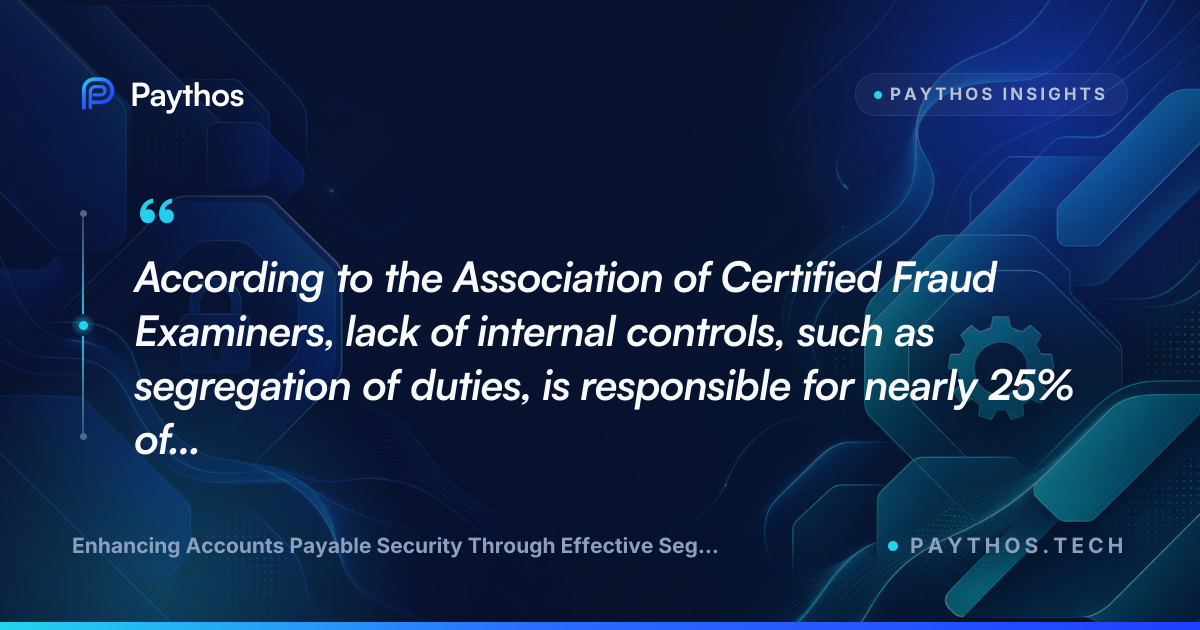
According to the Association of Certified Fraud Examiners, lack of internal controls, such as segregation of duties, is responsible for nearly 25% of all fraud cases within organisations (ACFE Report).
Best Practices for Implementing SoD in AP
To effectively implement segregation of duties in the accounts payable approval chain, consider the following best practices:
-
Define Clear Roles and Responsibilities: Outline specific roles for each individual involved in the AP process, detailing their responsibilities to remove ambiguity and overlap.
-
Utilise Technology: Implement AP automation tools that facilitate segregation of duties by enforcing approval workflows, thus ensuring multiple layers of checks. Paythos, for instance, offers configurable multi-step approval workflows, supporting compliance with SoD principles.
-
Conduct Regular Audits: Periodic reviews of the AP process can help identify flaws, inefficiencies, or potential areas of fraud. This allows management to adjust roles or check methodologies accordingly.
-
Train Employees: Regular training on the importance of SoD, potential risks of non-compliance, and how to use the systems in place can help reinforce a culture of accountability.
Detecting Invoices and Payments Fraud
Beyond the implementation of segregation of duties, it’s crucial to employ robust mechanisms to detect fraudulent activities. Examples include:
- AI Invoice Risk Scoring: Utilising technology to assess the risk associated with invoices, which can help to flag potential fraud or duplicate submissions.
- Vendor KYC/AML Screening: This ensures that vendors are legitimate and compliant with necessary regulations, thus reducing the chances of fraud.
By harnessing these technologies within a SoD framework, organisations can create a more secure and transparent AP process.
Challenges in Maintaining Segregation of Duties
While SoD offers substantial advantages, challenges often hinder its implementation:
- Resource Limitations: Smaller organisations may find it challenging to allocate enough staff to cover all necessary roles without overlap.
- Process Complexity: Depending on the size of the organisation, the AP process can become overly complex, making it difficult to maintain clear role assignments.
- Resistance to Change: Employees accustomed to a certain way of operating may resist new structures or technologies that impose stricter controls.
Conclusion
Effective segregation of duties within the accounts payable approval chain is critical to minimising financial risk and ensuring compliance in an ever-evolving landscape. By implementing best practices, leveraging technology, and conducting regular audits, organisations can significantly strengthen their internal controls.
Real-World Examples of Effective SoD Implementation
Examining how organisations successfully implement segregation of duties can offer valuable insights. Here are a couple of illustrative cases:
-
A Global Manufacturing Firm: This company employed a stringent SoD policy where invoice approval, payment execution, and reconciliation were strictly assigned to different teams. The outcome was a significant drop in invoice fraud incidents, with a reported 40% decrease in payment errors after implementing these controls. Furthermore, the company's risk assessment framework identified over 30% of its invoices as high-risk prior to deploying AI-driven risk scoring, underscoring the value of adopting advanced technologies.
-
A UK-based Retail Bank: Upon reviewing its AP processes, the bank found that a lack of SoD led to numerous unauthorized payments. By restructuring its AP activities and incorporating automated approval workflows, the bank achieved a 50% reduction in payment processing time, while also decreasing fraud attempts due to better monitoring of transactions.
Comparison Table: SoD Practices vs. Outcomes
| SoD Practice | Potential Outcomes | Real-World Example |
|---|---|---|
| Clear role definition | Reduced ambiguity and error rates | Global Manufacturing Firm |
| Regular audits | Early detection of fraud and discrepancies | UK-based Retail Bank |
| AI-driven risk assessments | Enhanced identification of fraud | Global Manufacturing Firm |
| Structured training programmes | Higher employee awareness and compliance | UK-based Retail Bank |
| Configurable workflow automation | Increased operational efficiency | Global Manufacturing Firm |
Employing these demonstrated practices and learning from others can further reinforce an organisation’s control environment, ultimately fostering greater security and transparency across the accounts payable process. Incorporating a structured approach to SoD not only minimises risks but also supports operational efficiency, aligning financial practices with broader organisational goals.
The Benefits of Segregation of Duties: Supporting Evidence
The importance of implementing segregation of duties extends beyond mere compliance; it actively enhances the financial integrity and operational efficiency within organisations. Consider the following evidence supporting the implementation of SoD:
-
Increased Fraud Detection Rates: According to the 2022 Benchmarking Report from the Business and Technology Advisory, organisations that enforced effective segregation of duties saw a 30% higher rate of detecting fraudulent activities compared to those without such measures in place (Frost & Sullivan).
-
Reduction in Financial Losses: Research by the Institute of Internal Auditors indicates that companies employing strong internal controls, including SoD, could reduce their financial losses from fraud by up to 66%. This highlights the significant cost-saving potential associated with implementing robust internal controls (IIA).
-
Improved Audit Performance: A report from Protiviti shows that organisations with implemented SoD principles are 40% more likely to pass external audits without significant findings. This reflects increased confidence in the accuracy of financial reporting due to effective internal controls (Protiviti).
These statistics underline the critical role that segregation of duties plays not only in fraud prevention but also in enhancing overall financial management and compliance efforts within organisations.
How Paythos helps
To facilitate excellent segregation of duties in the AP approval chain, Paythos offers several key capabilities:
-
Configurable Multi-Step Approval Workflows: This feature ensures that no single person has control over the entire payment cycle, enforcing segregation of duties effectively.
-
AI Invoice Risk Scoring: By introducing a risk-based approach to invoice review, Paythos helps identify potential fraudulent submissions that could evade traditional checks.
-
Vendor KYC/AML Screening: These capabilities ensure that all vendors are properly vetted, mitigating risks associated with fraudulent invoices or ghost vendors.
Implementing these features with Paythos allows organisations to enhance their AP controls, thus creating a transparent and secure environment.