Explore the strengths and weaknesses of Wise, Stripe, and local banks for international vendor payouts to optimise costs and efficiency.
Understanding Vendor Payout Options: Wise, Stripe, and Local Bank Rails
When it comes to managing international vendor payouts, finance teams have a variety of options at their disposal. Choosing the right payment method—whether it be Wise, Stripe, or a traditional local bank rail—can significantly impact transaction costs, speed, and overall efficiency. This guide will help CFOs, finance operations, and accounts payable teams navigate the complexities of these options, providing actionable insights backed by data.
Payment Method Overview
Let's briefly summarise what each option offers:
-
Wise: Focused on cross-border payments, Wise offers transparent fee structures and real exchange rates. Their service is often ideal for small-to-medium enterprises looking for cost-effectiveness when dealing with international vendors.
-
Stripe: Originally designed for eCommerce transactions, Stripe has expanded its services to support global payouts. It is best suited for businesses that require payment processing integrated with their sales platform, albeit generally at higher fees for cross-border payments.
-
Local Bank Rails: Traditional banks offer local payment services, which are often used for domestic transactions. While familiar, these solutions can have high fees and slow processing times, especially for international payouts.
When to Use Wise
Wise is particularly effective for small-to-medium enterprise (SME) payments where cost efficiency is crucial. Here are specific scenarios where Wise may be the best choice:
-
Low Transaction Values: Wise is advantageous for payments below $10,000, as it provides lower fees than most banks or payment processors.
-
Frequent Vendor Payments: For companies making regular international payments, Wise’s fee structure makes it cheaper over time.
-
Transparent Pricing: Wise’s real-time exchange rates and upfront fee disclosures allow finance teams to predict costs accurately.
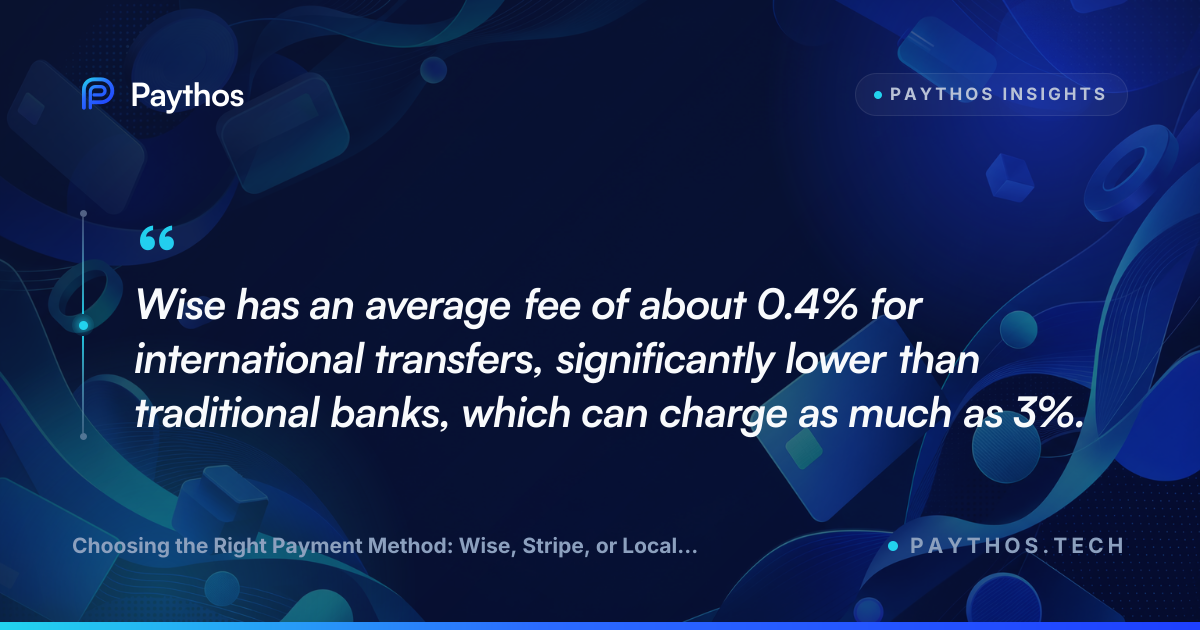
Data Insight: Wise has an average fee of about 0.4% for international transfers, significantly lower than traditional banks, which can charge as much as 3% (Wise Pricing).
When to Use Stripe
Stripe shines in environments where payment processing is integrated with other business functions, such as eCommerce platforms. Consider Stripe for:
-
E-Commerce Transactions: For businesses selling products online, Stripe offers seamless integration, enabling instant payouts to vendors as sales settle.
-
Subscription Services: If your company operates on a subscription model and frequently pays vendors based on customer payments, Stripe automates these in real-time.
-
Global Reach with Local Payment Options: Stripe supports a multitude of currencies and local payment methods, allowing for flexibility when dealing with different vendors worldwide.
Data Insight: Stripe charges a base fee of 2.9% + 30 cents for domestic transactions and can go up to 4% for international payouts (Stripe Fees).
When to Use Local Bank Rails
Local banks are often a familiar option, but they come with restrictions. Here are scenarios where local bank rails may be appropriate:
-
Domestic Transactions: For payments to vendors within the same country, local banks can offer lower fees and faster processing times.
-
Established Relationships: Long-term partnerships with local banks may result in customised terms and reduced fees, making it beneficial for large, predictable payments.
-
Security and Trust: Some firms prefer the assurance of using local banks, particularly when dealing with sensitive financial transactions.
Caveats: Local banks can lag in terms of speed and fees for international payouts. Depending on the bank, international wire transfers may take 3-5 business days and incur fees ranging from $30 to $50 per transaction.
Comparative Analysis
| Payment Method | Best Suited For | Average Fees | Speed |
|---|---|---|---|
| Wise | Small-to-medium enterprises, low-value payments | ~0.4% plus small fixed fees | 1-2 business days |
| Stripe | E-commerce, subscription services | 2.9% + 30¢ for domestic; up to 4% international | Instant payouts for settled sales |
| Local Bank | Domestic transactions, established relationships | $30-$50 for international transfers | 3-5 business days |
Making the Right Choice
As your finance team decides between these payment solutions, consider the following factors:
-
Transaction Size: Choose Wise for smaller international payments and local banks for larger domestic transactions.
-
Payment Frequency: Regular payments align best with Wise, while one-off transactions might be simpler with Stripe.
-
Integration Needs: If your operations depend heavily on eCommerce, Stripe might provide the best overall integration for processing.
-
Cost Sensitivity: Evaluate total costs versus the importance of speed—some scenarios may prioritise one over the other.
Rather than forcing a single choice, Paythos routes each vendor payout across Stripe, Wise, and local banking rails automatically, selecting whichever option is cheapest and most reliable for that specific payment.
Conclusion
The right payment option for vendor payouts can profoundly impact your organisation’s cash flow and operational efficiency. By understanding the benefits and limitations of Wise, Stripe, and local bank rails, finance teams can optimise vendor relationships while minimising costs. Careful consideration of factors like transaction size, frequency, and integration needs will lead to more informed decisions and better financial management.
For further reading on payment processing and shifting trends in finance, you may refer to:
By leveraging these insights and tools, financial leaders can enhance their strategic decision-making processes, ultimately driving success for their organisations in the international marketplace.